


Antisemitism under Hitler
Antisemitism was not purely a set of prejudices; it was a tool the Nazis used to build support, reshape German society and defend their actions at home and abroad. By turning Jews into both an “enemy within” and an “enemy abroad”, the regime could rally followers, change the law and present its policies as acts of self‑defence.
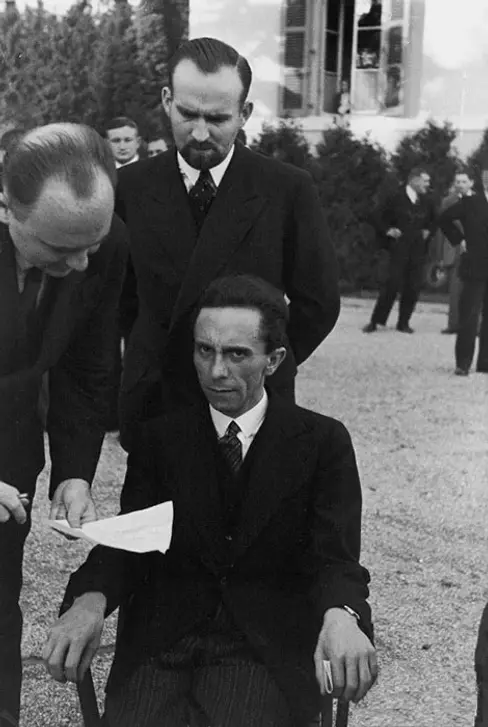
Blaming Jews for Germany's Problems
From the start, Nazi propaganda told Germans that “the Jew” was to blame for their problems. In his pamphlet “Why are we the enemies of the Jews?”, Joseph Goebbels claimed that Jews caused Germany’s misery and could have no place in a free, united nation. Julius Streicher’s call for a boycott of Jewish shops in March 1933 presented Jews as enemies of the state alongside Communists and Social Democrats. These messages gave people simple, emotional explanations for economic hardship and political chaos, and offered them a clear target for their anger.
Michael Zhang, '"Eyes of Hate" Seen in Portrait of Nazi Politician by Jewish Photographer', PetaPixel, 31 March 2013 https://petapixel.com/2013/03/31/eyes-of-hate-captured-in-portrait-of-nazi-politician-by-jewish-photographer/ [accessed 6 May 2026].

Turning prejudice into law and everyday life
“The Nazis didn’t just spread antisemitic ideas in speeches and posters; they wrote them into the law. In 1935, the Nuremberg Laws and the Reich Citizenship Law defined who would officially be considered Jewish and what that meant for people’s everyday lives. These laws took away Jews’ German citizenship, stopped them voting or serving in public roles, and squeezed them out of many jobs and schools. That way, the regime could claim it was simply bringing ‘order’ and ‘protecting’ Germans, while steadily pushing Jews out of public life without always needing noisy street attacks.”
United States Holocaust Memorial Museum, 'Samples of the Nuremberg Race Laws' https://encyclopedia.ushmm.org/content/en/photo/samples-of-the-nuremberg-race-laws [accessed 6 May 2026].


Selling war as a fight against 'the Jew'
During the Second World War, antisemitic propaganda helped the Nazis explain the conflict and keep support for the war going. Posters such as “Behind the Enemy Powers: the Jew” showed a caricatured Jewish figure pulling the strings behind London, Moscow and Washington, suggesting that “international Jewry” stood behind Germany’s enemies. Another poster, “He is to Blame for the War!”, pictured a well‑dressed Jewish man and told viewers that Jews, inside and outside Germany, were responsible for the war. By blaming Jews for the outbreak and suffering of the war, the regime could present harsh measures against Jews as part of a wider struggle for national survival.
123-456-7890
German History in Documents and Images, '"He is to Blame for the War!"', 1943/44 https://germanhistorydocs.org/en/nazi-germany-1933-1945/ghdi:image-5148 [accessed 5 May 2026].
Supporting Nazi control
When you put all of this together, antisemitism gave the Nazis real help in holding on to power. Blaming Jews offered people an easy answer to the question ‘who’s to blame?’, which made it simpler to get ordinary Germans behind the regime. The antisemitic laws and the constant propaganda joined up what was happening inside Germany with what was happening in the wider war, so it all looked like one big fight against a supposed Jewish enemy. So this part of the site shows how antisemitism could boost Nazi power in the short term. The next section asks the harder question: how far did the same beliefs push the regime into choices that actually made long‑term success less likely?
United States Holocaust Memorial Museum, 'Moving into the Lodz Ghetto' https://encyclopedia.ushmm.org/content/en/photo/moving-into-the-lodz-ghetto [accessed 6 May 2026].
